
Put on Stevie Wonder’s “Higher Ground” and listen to the first two seconds. That rubbery, talking, quacking clavinet — the thing the whole song rides on — is a clavinet played through a Mu-Tron III, a pedal that came out of a small New Jersey factory in the early 1970s. The man who designed it was Mike Beigel, an MIT-trained electrical engineer who, by his own account, had no idea what the circuit would be used for in music when he built it. He died at home in September 2026, at 79. Most of the people who have ever heard his sound never heard his name.
The kid with the oscilloscope
Michael Lee Beigel was born in January 1947 in New York City, to Jerome and Freda Beigel (the NAMM Foundation lists the date as January 29). At 14 he bought an oscilloscope and started studying wave theory. He also played classical clarinet, seriously enough that the Manhattan School of Music was a real option — but he chose MIT instead, partly, as he later put it, because it gave him a better chance of making a living. He entered at 17.
What he did there, according to the family obituary:
- Graduated in the class of 1970 with degrees in electrical engineering and in humanities and engineering — what the obituary calls “MIT’s first double major in Electronic Music.”
- Co-hosted an MIT radio show called The Electric Chair, per Premier Guitar.
- Served as president of Identic Data Inc., an R&D group, while still a student.
That R&D group lost its funding in the 1970 stock market crash. Beigel moved to Warwick, New York, and founded Beigel Sound Lab to finish a synthesizer he was building for Guild, the guitar company. Then Guild’s founder, Al Dronge, died in a private plane crash, and Guild cancelled the project.
From a dead synthesizer to a pedal
The synthesizer wasn’t a total loss. Aaron Newman, a chief engineer at Guild, saw something in the system, and the two of them pulled two pieces out of it — an envelope follower and a voltage-controlled filter — and shrank them into a guitar pedal. The internal code name was “Auto-Wah.” The prototype was working by the summer of 1972, the same year Beigel and Newman co-founded Musitronics in Rosemont, New Jersey. An investor later shortened the company name on the product to “Mu-tron.” By Chris Gill’s 1997 account in Vintage Guitar, the factory was a converted chicken coop that grew to roughly 35 employees and became the town’s largest employer — details that, as far as we can tell, rest on that one article.
The idea itself is on file with the U.S. Patent Office as No. 3,911,776, “Sound effects generator,” inventor Michael L. Beigel, assignee Musitronics Corp., filed November 1, 1973, and granted October 14, 1975. Stripped of the legal language: it’s a filter whose peak frequency follows the envelope of the signal itself. Play soft and the filter sits low; dig in and it sweeps open. The pedal listens to how hard you hit the note and responds — a wah pedal that follows your own dynamics. It was one of roughly 45 U.S. patents he would hold over his life, according to his family and the outlets that covered his death.
“I had no idea what it would be used for in music,” he said of those early days.
The record that made the name
Somebody figured it out quickly. Stevie Wonder’s “Higher Ground” was released as a single in July 1973, from the album Innervisions, and climbed to No. 4 on the Billboard pop chart and No. 1 on the R&B chart. The clavinet was running through a Mu-Tron III. (A few obituaries have dated the song to 1974; it’s 1973.)
Wonder didn’t just use the pedal; he came out to the company. “He came out to play some music with us and talk,” Beigel recalled. “He was a great, open-minded guy.” Wonder agreed to appear on a Musitronics promotional poster, and Beigel credited the song with putting the company “on the map.” His description of it says a lot about how he thought: “a perfect example of something I had hoped for but couldn’t myself conceive.”
The list of people who ran through a Mu-Tron III after that reads like a cross-section of 1970s music, per the obituaries, NAMM, and Vintage Guitar:
- Jerry Garcia
- Bootsy Collins and Frank Zappa
- Jazz players Larry Coryell, Joe Zawinul, and Chick Corea
- George Duke, George Benson, Lee Ritenour, and Andy Summers, according to Gill
What else came out of the factory
The Mu-Tron III was the hit, but Musitronics kept building:
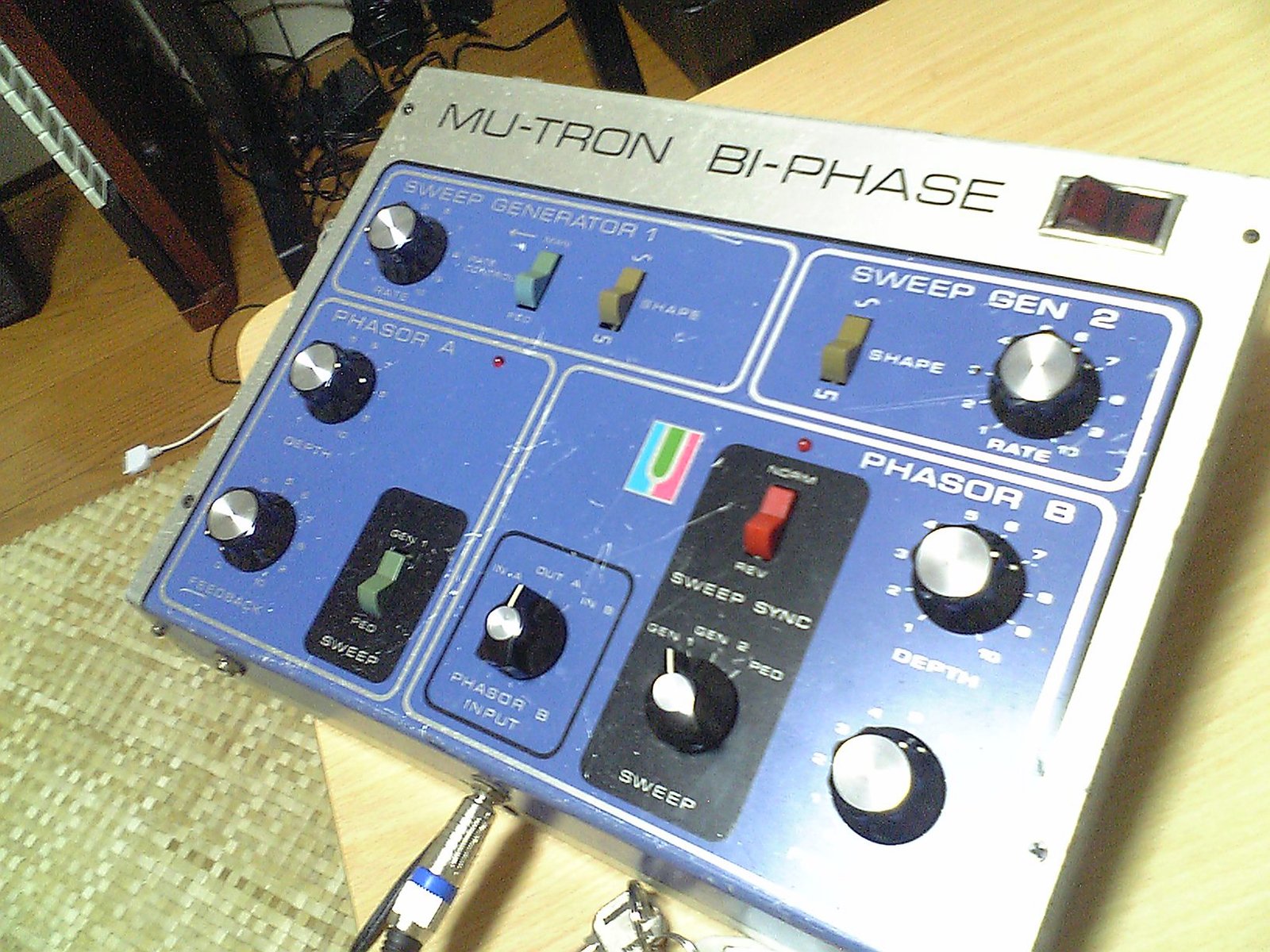
- The Bi-Phase, a dual phaser
- The Phasor
- The Micro-V
- The Volume-Wah
- A Flanger — only about 1,000 were made, and it was the company’s last product before the sale to ARP
- The Dan Armstrong line of plug-in effects, including the Orange Squeezer compressor
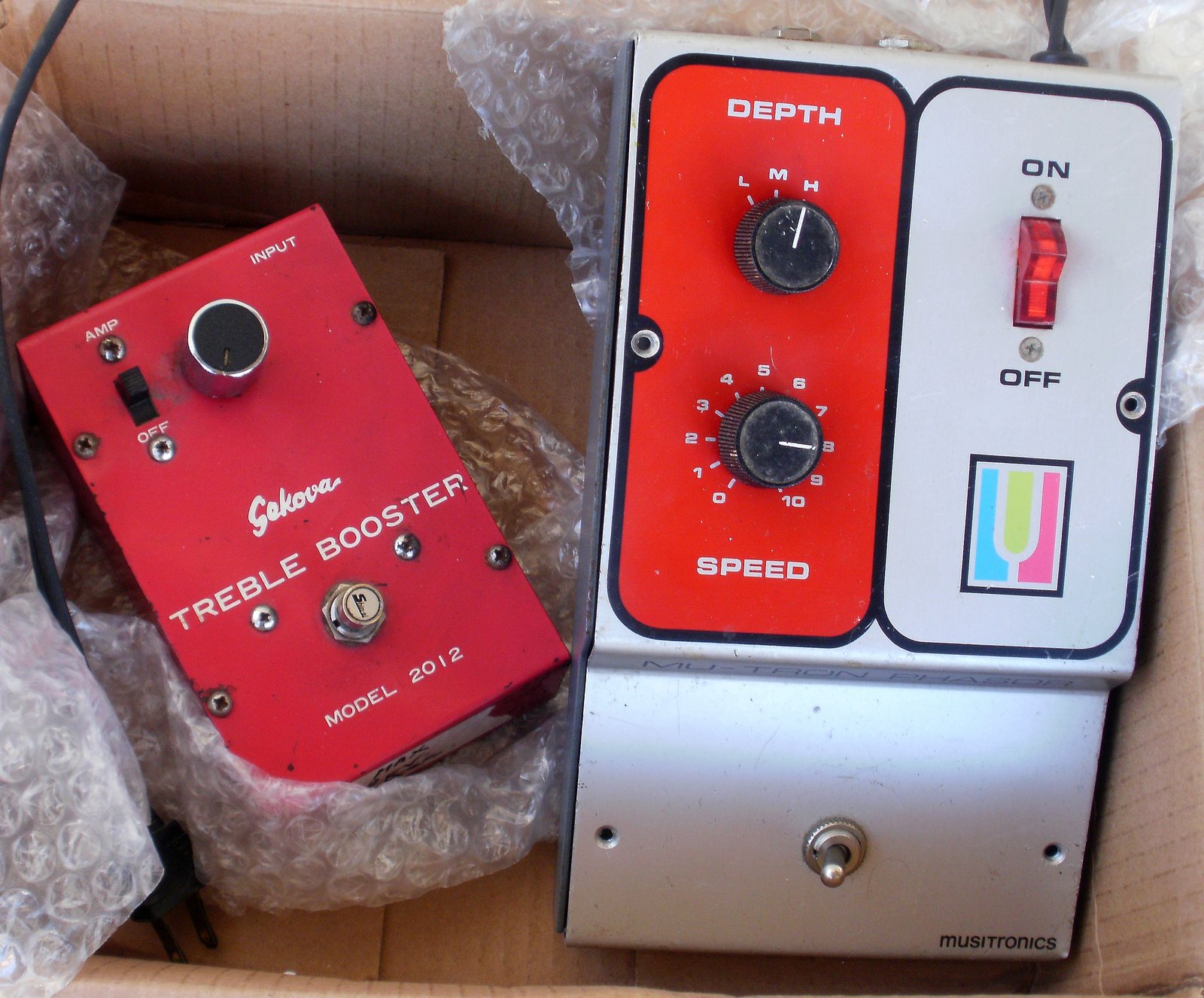
Here is Beigel himself, in a 16-minute conversation with Reverb, talking through the story of the Mu-Tron:
The Gizmotron
The thing that ended Musitronics wasn’t a pedal at all. The Gizmotron was a mechanical gadget dreamed up by Kevin Godley and Lol Creme of the band 10cc — a device that mounted on a guitar and bowed the strings with small motorized wheels — and Musitronics took on the job of turning it into a product. Beigel called it “an R&D nightmare that basically ate up the company.” Newman put it more bluntly: “Our downfall was the Gizmotron.”
Beigel left in 1978 after the board chose to keep pouring money into the Gizmotron rather than back his proposal for digital audio. ARP bought Musitronics in late 1978 or 1979; Beigel said he never received a first royalty check. ARP itself went broke in 1981, he said. He summed it up without much varnish: “The tragic end was the loss of Musitronics, the loss of a million bucks, and the loss of my career for quite a while.”
Penguins, tortoises, and a second act
“For quite a while” turned out to be true, but it wasn’t the end. Beigel kept working in industrial and product design through roughly 1988, and in 1978 — the same year he walked away from Musitronics — he started the work that would become his second career: RFID bio-identification, the radio-tag technology now used to identify animals. He consulted for AVID, the pet-ID company, and built something called the Penguin Weighbridge, a device that weighed Adélie penguins, for the New Zealand Antarctic Program and the U.S. National Science Foundation. It was later adapted for Mojave Desert tortoises.
Then the music business came back for him:
- From 1996, he designed Electro-Harmonix’s Q-Tron.
- In 2012 he re-founded Beigel Sound Lab.
- In 2013–14, under the Mu-FX name, he released the Tru-Tron 3X, built around the original Mu-Tron circuitry.
- In February 2025, Behringer announced a B-Tron III clone — a backhanded kind of tribute, but a tribute.
- In 2025 the Recording Academy gave him a Certificate of Recognition, and on June 9, 2025, NAMM sat him down for an oral-history interview.
The man you don’t know
Outside the lab he was a photographer, a traveler, a gardener, a birdwatcher, and a watersports enthusiast, according to his family. He is survived by his daughter Romy, an industrial engineer at Boeing. Since 2025 the family has worked with Forgotten Futures to preserve his prototypes; they’ve invited donations in his memory at forgottenfuturesmusic.org and are sharing stories at the Instagram account @mikebeigelmusic.
“Mike was a true innovator and pioneer of electronic music products,” the family said in a statement carried by Sound on Sound. Electro-Harmonix, the company he designed the Q-Tron for, said: “We are all saddened to hear the news of Mike Beigel, an immensely talented engineer and inventor.”
Beigel died at home in September 2026, at 79 — NAMM gives the date as September 21; the family obituary doesn’t name a day, and the New York Times didn’t run its obituary until October 29. No cause was given. The family obituary notes that he lived most of his life with Dercum’s disease, a rare chronic condition, but does not say it caused his death. Some outlets reported his age as 77; the birth and death years make it 79.
He had a line he liked: “Don’t get hyped on your own con.” It’s good advice from a man who built a sound that made other people famous, lost the company that made it, weighed penguins in Antarctica, and then came back decades later to build the same filter again — this time with his name on it.

Sources
- Barton Family Funeral Service obituary
- The New York Times obituary
- Relix, “Mike Beigel 1947–2026”
- JamBands, “Mike Beigel 1947–2026”
- Sound on Sound, “Mike Beigel: 1947–2026”
- NAMM Oral History, Mike Beigel
- Premier Guitar, “Builder Profile: The Mu-Tron Story”
- Pedal of the Day, interview with Mike Beigel (2017)
- Chris Gill, Vintage Guitar (1997), “The Stomping Ground: Musitronics, Mu-Tron and the Gizmotron”
- Google Patents, US3911776A, “Sound effects generator”
- Wikipedia, “Mu-Tron III”
- Wikipedia, “Higher Ground (Stevie Wonder song)”
- GuitarBomb