
June Jones spent five decades running an offense built to break one of football’s oldest rules: abandon the running game almost entirely and throw the ball on nearly every down. He didn’t invent the run-and-shoot, but he’s the one who carried it out of a defunct spring league, into an NFL quarterback room, and finally into a Hawaii program that had just gone winless — then, within nine seasons, to an undefeated regular season nobody there had seen before or since.
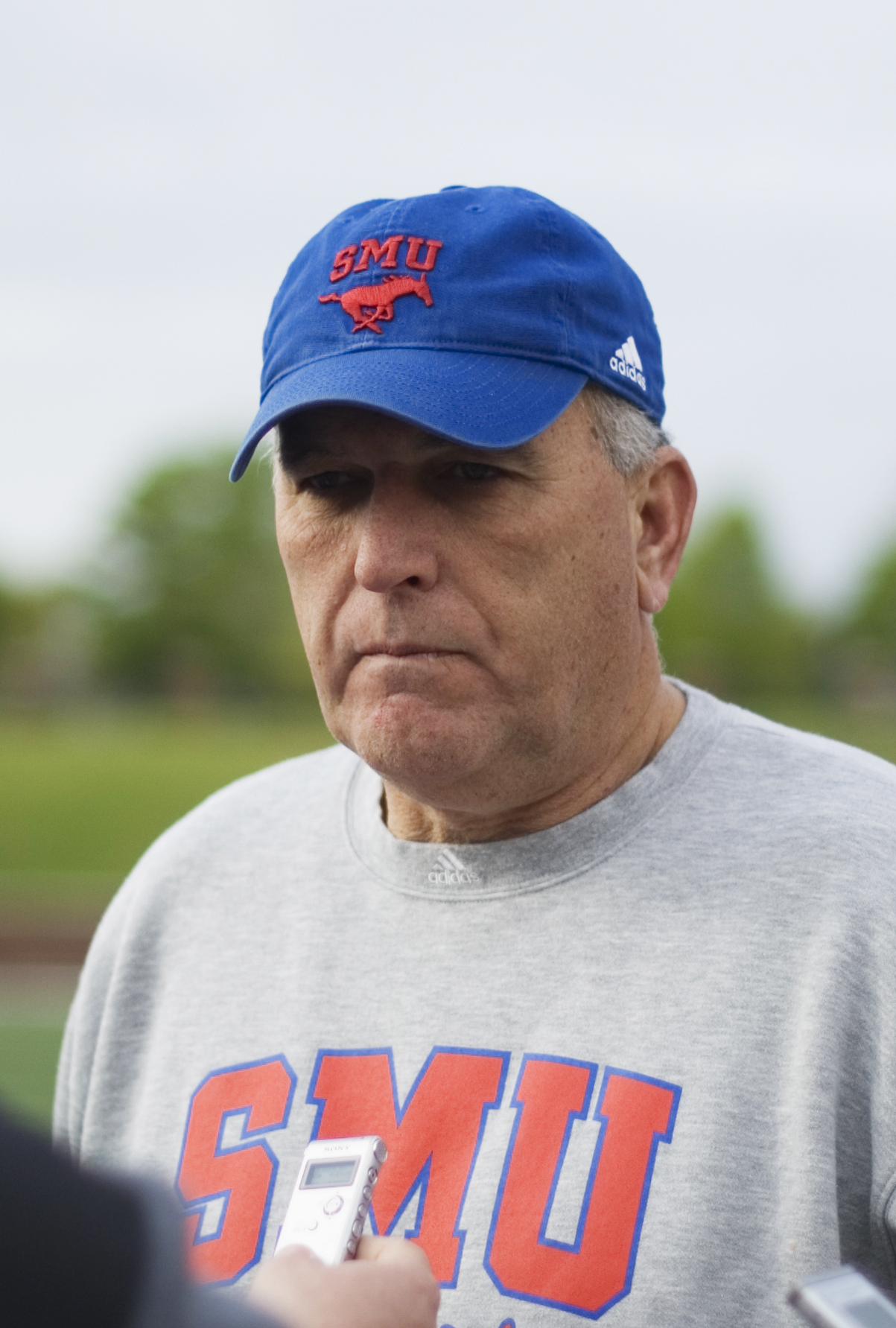
Jones on the sideline during spring practice as SMU’s head coach, April 2009. Photo: Jmcstrav at English Wikipedia, CC BY-SA 3.0.
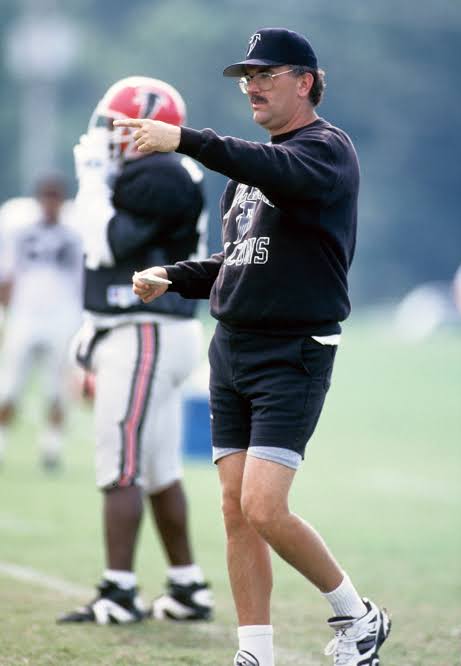
He learned the system by playing quarterback for it. Jones came through Oregon, the University of Hawaii, and finally Portland State, where coach Mouse Davis installed the run-and-shoot in the mid-1970s — four receivers spread wide, reads made pass-first on nearly every snap, no fullback, almost no tight end. It was heresy by 1970s college-football standards, and it’s a big part of why Jones spent parts of five NFL seasons as a backup quarterback for the Atlanta Falcons and one more in the CFL before he found his way back to the only offense he actually believed in, according to Bleacher Report.
He followed Davis into coaching — first with the USFL’s Houston Gamblers, then as the Houston Oilers’ quarterback coach in 1987, where the run-and-shoot ran through Warren Moon’s hands under head coach Jerry Glanville and turned Houston into one of the NFL’s most dangerous passing offenses. Atlanta made him a head coach in 1994, and for three seasons the Falcons ran it too, reaching the playoffs in 1995. A year as interim head coach in San Diego followed in 1998 — and then Hawaii called.
The program Jones inherited had gone winless the year before. What followed, over nine seasons:
- 1999: 9-4 in his very first season, with a bowl win over Oregon State — what Bleacher Report called the greatest single-season turnaround in NCAA history.
- 76–41 overall across nine years, with two Western Athletic Conference titles.
- 2007: a 12-0 regular season, Heisman finalist quarterback Colt Brennan at the helm, capped by a Sugar Bowl berth.
It left him the winningest coach in the program’s history, a record that still stands, according to Yahoo Sports.
Jones was also known for recruiting players other programs wouldn’t touch — eligibility questions, hard-luck backgrounds, more talent than paperwork. Davone Bess, a receiver who went on to a seven-year NFL career, was one of them. “He took a chance on a kid from Oakland who didn’t have other options,” Bess said. “I’m forever grateful,” according to the Honolulu Star-Advertiser.
Jones kept coaching for another thirteen years without ever really stopping:
- SMU (2008–14): 36-43, the program’s first trip back to bowl contention in 25 years, before he resigned.
- Hamilton, CFL (2017–18)
- Houston Roughnecks, XFL (2020): went 5-0 under him before the league folded, per Bleacher Report.
Tributes after his death leaned on the same word from nearly everyone who played for him or against him: visionary. “He believed in giving people chances,” said Timmy Chang, Jones’s old quarterback and Hawaii’s current head coach. Mouse Davis, his 94-year-old mentor, put it more simply: “He was like my son. He was very special. He would do anything for you.” Longtime friend Artie Wilson, who met Jones as a teenage ballplayer in 1970, said it plainest of all: “This isn’t my loss, this is Hawaii’s loss,” according to the Star-Advertiser.
Jones died October 29, 2026, in Portland, Oregon — his hometown — at 73. He’d entered hospice care roughly two weeks earlier; the Honolulu Star-Advertiser attributed it to Type 1 diabetes and spinal problems, while longtime friend Hal Mumme told Yahoo Sports doctors found a tumor after Jones went in for severe back pain. The two accounts were never reconciled publicly. The term “run and shoot” barely survives as its own label anymore — it’s been folded into the spread and air-raid systems that now run most of college football and a good share of the NFL. But the lineage runs straight through the quarterback rooms Jones built, from Warren Moon to Colt Brennan, each one asked to do the same heretical thing: throw it, almost every down, and trust the offense to work.