
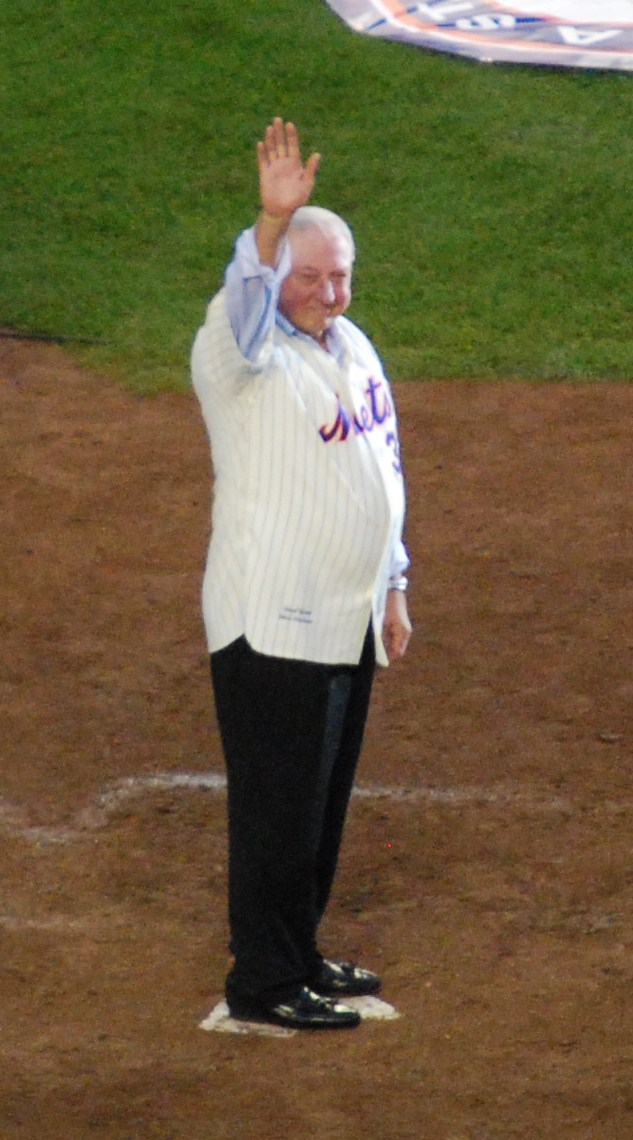
Jerry Koosman, the left-hander who got the final out of the Miracle Mets’ 1969 World Series win over the Baltimore Orioles, died Sunday, Nov. 1, 2026, at 83. Mets spokesman Jay Horwitz told the Associated Press that Koosman had been sick for about a year and died of multiple illnesses in Osceola, Wisconsin, surrounded by his children. The image he left behind is the one in every Mets highlight reel: Koosman leaping into catcher Jerry Grote’s arms on the Shea Stadium mound. The career behind it is bigger than that one frame, and it nearly never happened.
The $50 loan
Jerome Martin Koosman was born Dec. 23, 1942, in Appleton, Minnesota. After pitching for an Army team, he signed with the Mets on Aug. 27, 1964, for $1,600, according to the AP and the Society for American Baseball Research (SABR). His 1965 season did not look like a future star’s: SABR lists him at 5-11 with a 4.71 ERA at Class A Greenville, then 0-2 in two Double-A starts, and says the Mets were on the verge of releasing him. As SABR tells it, farm director Joe McDonald was about to let him go when he remembered something: Koosman and two other minor leaguers had wrecked a car on the way to their assignments, and he had asked McDonald for $50 more to buy a replacement. McDonald decided to let the lefty work off the debt first.
Then a pitching instructor, former major leaguer Frank Lary, taught him a slider. At Class A Auburn in 1966, Koosman led the New York-Penn League with a 1.38 ERA, per SABR, and by the next spring he was in the majors. He made his debut April 14, 1967, with 2 2/3 hitless innings of relief in Philadelphia, according to the AP.
1968: second by one vote
Koosman made the Mets for good in 1968. His first start was a four-hit shutout at Dodger Stadium, per the AP. The rookie finished 19-12 with a 2.08 ERA, and he was picked for the All-Star Game, where he struck out Carl Yastrzemski for the final out of a 1-0 National League win. In Rookie of the Year voting he finished second to Cincinnati catcher Johnny Bench; SABR says the margin was a single vote, the closest to that time. He was the No. 2 starter behind Tom Seaver, with a young Nolan Ryan on the same staff.
October 1969
The Mets had never finished with a winning record before 1969. They won 100 games, and Koosman went 17-9 with a 2.28 ERA, per the AP. The Orioles beat Seaver 4-1 in the World Series opener, and Koosman evened it in Game 2. His two starts, as the sources give them:
- Game 2: one run over 8 2/3 innings in a 2-1 win (AP); MLB.com notes the Orioles had no hit until Paul Blair singled in the seventh.
- Game 5: a complete-game five-hitter in a 5-3 clincher at Shea (AP).
Game 5 also holds the most argued-over baseball in Mets history. With the Mets down 3-0 in the sixth, Cleon Jones said a pitch from Dave McNally had hit his foot. The ball bounced to Koosman in the dugout, where manager Gil Hodges stood by him. “As I bent down, Gil says: ‘Swipe it against your shoe,’” Koosman told Mets broadcaster Howie Rose, per the AP. Hodges showed the ball to the umpire, who sent Jones to first, and Donn Clendenon followed with a two-run homer. Koosman said in a 2008 interview, as SABR quotes it: “Whether it was mine or Cleon’s is debatable.” Seaver’s comment on the story, also in SABR: “Koozy loves to tell stories.”
The ninth inning was, Koosman said, the toughest he ever pitched: “You couldn’t hear yourself think,” he told SABR in a 2008 interview. He walked Frank Robinson, got Boog Powell to force him, and then Brooks Robinson flew out. Davey Johnson lifted a fly to left field. “Now the only other thing is: Don’t drop the ball,” Koosman told Rose. Jones didn’t, and Koosman jumped into Grote’s arms. In the clubhouse afterward, he recalled, “We were so choked up with emotion we couldn’t talk.” Over the Series he went 2-0 with a 2.04 ERA, allowing seven hits in 17 2/3 innings, per SABR.
Watch the final outs
After 1969
Koosman spent 12 seasons with the Mets, 1967 through 1978, and the numbers show how much the team around him changed:
- 1976: 21-10, the most wins of his career, and second to San Diego’s Randy Jones in the Cy Young Award voting (SABR; MLB.com confirms the 21 wins).
- 1977 and 1978: 11-35 combined with a 3.62 ERA, as the Mets collapsed, per MLB.com. Seaver was traded to the Reds in June 1977.
- With the Mets overall: 140-137, 3.09 ERA.
After the 1978 season he told the team he would retire unless it traded him, and in December the Mets sent him to the Minnesota Twins. The player the Mets received to complete that deal, left-hander Jesse Orosco, was the pitcher on the mound for the last out of the Mets’ 1986 World Series win, MLB.com notes, so the franchise’s two championships ended with two pitchers who were once part of the same trade. Koosman went on to pitch for the Twins (1979-81), the White Sox (1981-83) and the Phillies (1984-85). In 1984 he gave up Pete Rose’s 4,000th career hit, the AP notes. He retired after the 1985 season with a 222-209 record, a 3.36 ERA and 2,556 strikeouts across 19 seasons, with 140 complete games and 33 shutouts, per the AP and MLB.com.
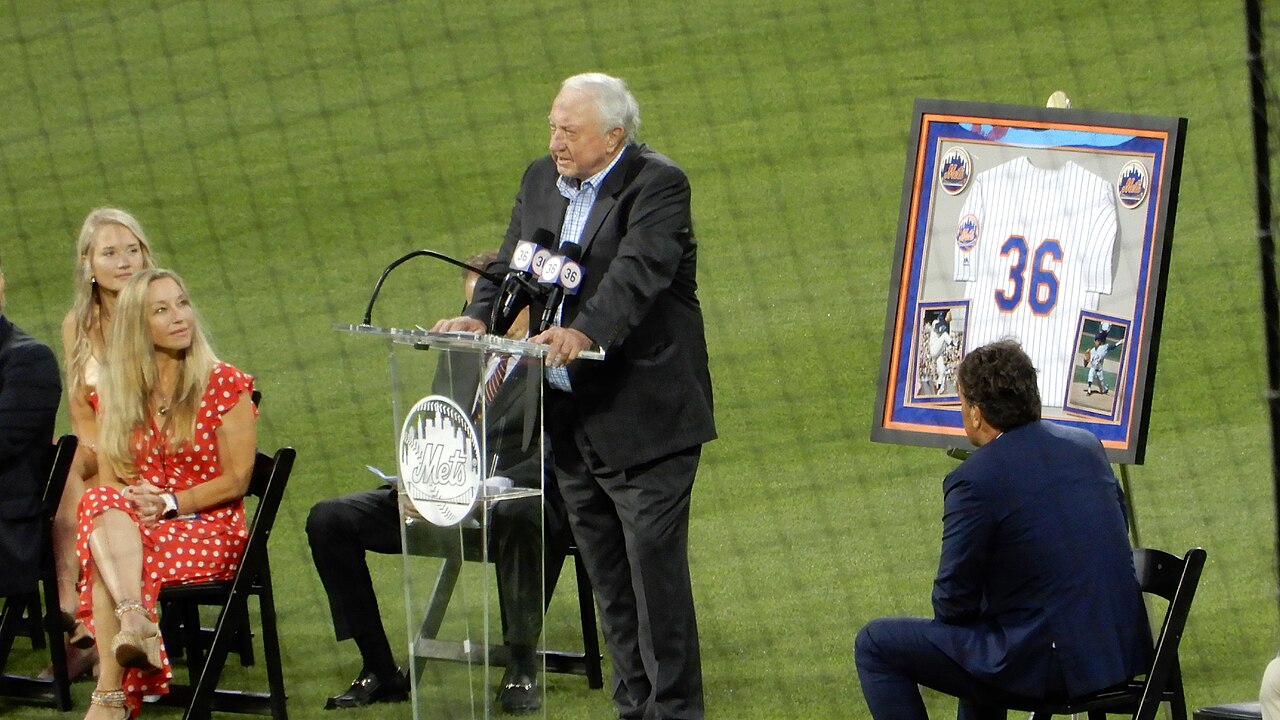
The Hall of Fame never followed. By SABR’s count he received four votes on the 1991 ballot, his only year on it, and Seaver said that without his injuries “he’d have been in the Hall of Fame.” The Mets inducted him into the team’s own Hall of Fame in 1989, per SABR, and on Aug. 28, 2021, retired his No. 36, making him the third player in franchise history to receive that honor, after Seaver (41) and Mike Piazza (31), MLB.com reports. “I’m thankful that they thought so much of me to retire my number,” he said that day. Former teammate Ron Swoboda called him “a warrior” in 2021, MLB.com notes. SABR also records what Roberto Clemente reportedly said of Koosman’s fastball: that it was the only one he ever saw “that never moved the same way twice.”
A hard chapter
In 2009, Koosman pleaded guilty to federal tax evasion. The New York Daily News reported that he did not file federal returns for 2002 through 2004, and that prosecutors said the unpaid taxes came to as much as $80,000. On Sept. 3, 2009, a federal judge sentenced him to six months in prison, half of the maximum. Before sentencing he told the court he had been “suckered” by the anti-tax movement, according to the Daily News, and said, “I take full responsibility.” The judge called it “a serious blemish on an otherwise outstanding life,” per the same report. The paper also reported that he had sold the ball from the final out of the 1969 Series sometime in the 1990s and could not remember who bought it.
The last year
Koosman’s obituary, published by DrydenWire, says he died peacefully at his home in Osceola, Wisconsin. It describes a man who loved golf, fishing, hunting and cooking for the people he loved, and who “could also spend hours researching just about anything on the computer.” He is survived by sons Michael and Shawn and daughter Danielle, along with four grandchildren and his brothers Orville and Elton. A memorial service is set for 11 a.m. Friday, Nov. 13, 2026, at Peace Lutheran Church in Dresser, Wisconsin, with a private burial later.
Sources
- Associated Press (via ABC News), “Jerry Koosman, who got final out in 1969 Mets’ World Series victory, dies at 83” (Nov. 2, 2026)
- MLB.com, Bill Ladson, “Koosman, iconic Mets southpaw who clinched ’69 WS, passes away at 83” (Nov. 1, 2026)
- Society for American Baseball Research, Irv Goldfarb, “Jerry Koosman” (BioProject)
- DrydenWire, obituary of Jerry M. “Kooz” Koosman
- New York Daily News, “‘Miracle Met’ Jerry Koosman goes off to prison for failing to pay taxes” (Sept. 4, 2009)