
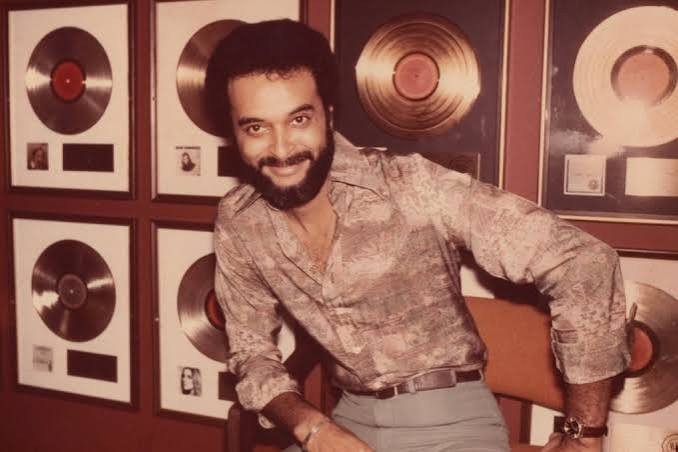
Gerry Griffith, the Arista Records A&R executive who persuaded Clive Davis to come and watch a young Whitney Houston sing, died Nov. 5, 2026, in Brooklyn, New York. He was 87. He died after a five-year battle with dementia, according to Billboard and an obituary submitted to EURweb on behalf of his daughter, Falcon. Davis signed Houston to Arista, and the credit for finding her became a sore point between the two men. Griffith’s own description of his part was modest. “I didn’t actually discover her,” he told Complex in 2012.
Chicago, the Army and three labels
Griffith was a Chicago native and a U.S. Army veteran, according to Billboard and EURweb. In the 2012 Complex interview he said he came from the city’s South Side.
Before Arista he worked at Motown, Philadelphia International Records and Columbia Records. Complex’s introduction to that interview said that at Columbia he “became the first African-American product manager.”
The Arista years
At Arista, Griffith worked in A&R, the department that finds artists and matches them with songs. The names the obituaries attach to him:
- Aretha Franklin, Dionne Warwick, Phyllis Hyman and Minnie Riperton, according to Billboard
- Jennifer Holliday and Dave Valentin, according to EURweb
- Whitney Houston’s “How Will I Know” and “I Wanna Dance With Somebody,” two songs that Brenda Andrews of Rondor credits to him
- The soundtracks to “Pretty Woman” and “The Bodyguard”
In 2012 he told Complex that Carol Ware urged him to listen to “Run to You” and that he passed the song to David Foster. It went on “The Bodyguard” soundtrack and earned an Oscar nomination for Best Original Song, according to EURweb.
Billboard’s obituary also says he worked with Carlos Santana on the Grammy-winning album “Supernatural.” EURweb says only that he was involved in projects connected to it.
How Whitney Houston got to Clive Davis
The accounts agree on the outline: Griffith saw Houston perform, believed in her, and got Davis into a room to hear her. They differ on when he first heard her.
Griffith’s own telling, to Complex in 2012, went like this:
- He first saw her about two years before Arista signed her, at the Bottom Line, singing backup for her mother, Cissy Houston.
- Richard Smith, the label’s promotions head, urged him to sign her. Griffith thought she was too young.
- Later, hearing she was headed to Elektra, he contacted her manager, Gene Harvey, and went to see her at Seventh Avenue South.
- He pitched her to Davis, who paid for a showcase after about a week of rehearsal. As Griffith recalled it, she was about 16.
- Davis first offered a three-song deal. After the showcase, he offered two albums.
Griffith added that Cissy Houston never asked him to sign her daughter.
Other versions put the dates differently:
- Majic 102.1, in a February 2012 interview, dated his first sighting to 1983 at Seventh Avenue South, and said an unconvinced Davis agreed to a three-song demo after about five days of rehearsal.
- Billboard’s obituary says he first heard her in 1979, when she was 16 and singing with her mother, and was “more captivated” in 1983. Amid rumors that another label was close to signing her, it says, he got Davis to attend a showcase and she signed that year.
- EURweb quotes Deirdre O’Hara as saying she was the one who urged Griffith to go and see Houston, and that he then brought Davis.
What Griffith saw did not change from one telling to the next. “I hadn’t seen an artist like her since Aretha,” he told Majic 102.1 in 2012. “I had no doubt that she would be an artist for the world.” Billboard quoted him as saying that even young she showed “a fearless confidence and stage presence.”
The credit
On Davis taking the credit for Houston, Griffith told Complex: “No, it upset me.” He said that was “why I left the company.”
By his account he left Arista after negotiating a deal with EMI Manhattan Records, and Davis rehired him four or five years later. He also held a senior A&R post at EMI’s Manhattan Records, where he worked with Richard Marx, according to Billboard and EURweb.
In the same interview he said he had “the utmost respect” for Davis, that things between them were “cool,” and that “It’s always business.”
Of Houston, he told Complex: “there will never be another voice like that, ever.”
The last headline
Gerry Griffith died on Nov. 5, 2026, in Brooklyn, at 87. The news came in an obituary submitted to EURweb on behalf of his daughter, Falcon, and was reported by Billboard on Nov. 13. He is survived by two daughters and two sons. A memorial will be held at a later date.
“The music industry has lost a truly great record executive and a truly nice guy,” said Ray Harris of the Living Legends Foundation, according to EURweb.
Brenda Andrews put the case for him plainly. “Gerry never got the accolades he so deserved for discovering Whitney Houston,” she said, according to Billboard.
He said he didn’t discover her. He heard her, argued for her, and got the man who could sign her into the room. He died at 87.