
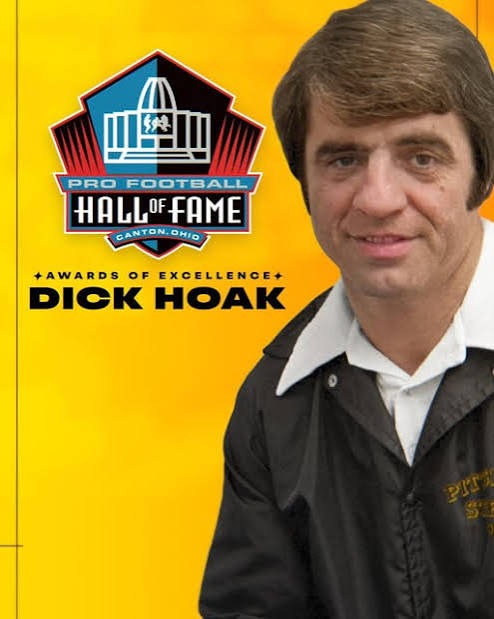
The Steelers announced on Wednesday, Nov. 11, 2026, that Dick Hoak had died at 86. No cause of death was given. Hoak spent 45 seasons with the team: ten as a running back, from 1961 to 1970, and then 35 as its running backs coach, from 1972 through the 2006 season. He was on the staff for all five of the Steelers’ first Super Bowl wins.
When he retired, he summed it up this way: “I beat the system. Coaches are hired to be fired. I was hired, but I was never fired.”
A Jeannette kid who stayed home
- Born Dec. 8, 1939, in Jeannette, in Westmoreland County, Pennsylvania.
- At Jeannette High School he played quarterback and defensive back. The 1956 team went 10-0 and won the Western Pennsylvania title game, 16-13 over Charleroi, on a late field goal. In basketball he once held the school’s single-game scoring record, 39 points.
- At Penn State he played quarterback, running back and safety from 1958 to 1960, and was voted team MVP in 1960. In the 1960 Liberty Bowl, a 41-12 win over Oregon, he was the game’s MVP, with two rushing touchdowns and two passing touchdowns.
- The Steelers took him in the seventh round, 90th overall, of the 1961 draft.
The draft pick kept him at home. “I played in Jeannette. I went to Penn State. I got drafted here, played here. I had some opportunities to leave. … I never left. It was my hometown.”
The lean years
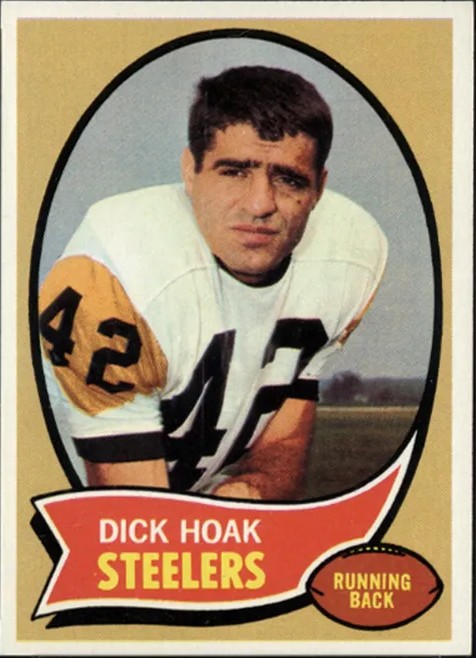
As a player he went through four head coaches, Buddy Parker, Mike Nixon, Bill Austin and Chuck Noll, in what was then a lean stretch for the franchise. His numbers:
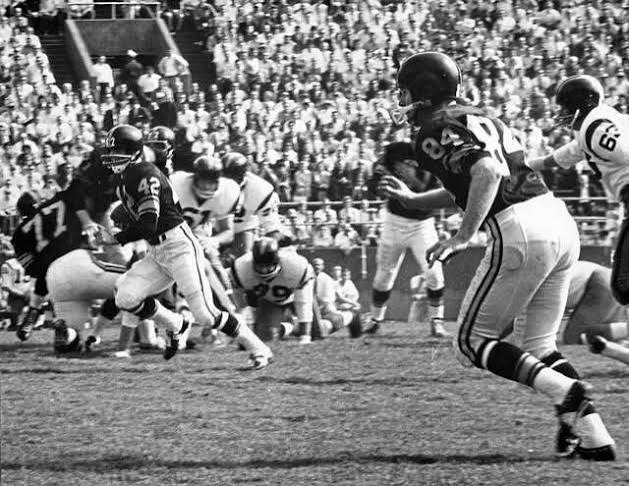
- 3,965 rushing yards and 25 rushing touchdowns, plus 146 catches for 1,452 yards.
- 5,417 yards from scrimmage and 33 touchdowns in all.
- Second on the Steelers’ career rushing list when he retired after the 1970 season. He is still eighth.
- The Pro Bowl in 1968, when he ran for 858 yards at 4.9 a carry, including the longest run from scrimmage in the league that year.
He was frank about it. “I couldn’t have played today, I can tell you that,” he said. “At that time I was decent, I guess. But every year they kept trying to replace me. I wouldn’t play the first three or four games because I was too small, too slow, but by the fourth or fifth game, I was the guy playing. I just stuck with it and made a career out of it.”
Noll, Franco and a seat in the coaches’ box
After the 1970 season he spent a year teaching and coaching high school football in Wheeling, West Virginia. In 1972 he had two coaching offers within days of each other, one from Pitt’s Carl DePasqua and one from Noll. He interviewed with both on the same day and took Noll’s.
His first assignment was the team’s first-round pick, Franco Harris. “Franco made my job very easy,” Hoak said. “His rookie year was my first year coaching. Coach Noll gave me some good advice after about a month with him. He said, ‘Dick, just don’t over-coach him.’ So I just let him be himself.”
Rocky Bleier, wounded in Vietnam and fighting to resume his football career, needed something different. “When I came back from the service, Dick was there,” Bleier said after Hoak’s death. “The way he coached is the way that he had played. The fundamentals that he learned are what he taught us about stance and reading holes.”
On Dec. 23, 1972, Hoak watched the Steelers’ playoff game against the Raiders from the coaches’ box, next to defensive backs coach Bud Carson. He was known for staying even-keeled. Then Harris caught the deflected pass just off the grass and ran for the winning touchdown, the play that became the Immaculate Reception. “I jumped up on the table,” Hoak said. “I went crazy up in the box and yelled, ‘Run Franco, run.’” The only other time he reacted that way, he said, was Willie Parker’s 75-yard touchdown run in Super Bowl XL.

“It wasn’t just the play, it was the year,” he said of 1972.
Hoak was a coach on five Super Bowl winners:
- Super Bowls IX, X, XIII and XIV under Noll.
- Super Bowl XL under Bill Cowher, with Jerome Bettis and Parker in the backfield.
The man who would not leave
In 1983 the new Pittsburgh Maulers of the rival USFL, owned by the DeBartolo family, offered Hoak their head coaching job. He said no. “I just couldn’t see myself going across the street to a rival football league in Pittsburgh,” he said. “There was no way I could have done that.” The Rooney family, who own the Steelers, had always been good to him.
Noll retired on Dec. 26, 1991. Dan Rooney hired Cowher on Jan. 21, 1992, and Cowher kept exactly one assistant from Noll’s staff: Hoak. Cowher was 34 and a first-time head coach. “He was a conduit for me,” Cowher said. In the booth, when it came time to decide on a challenge flag, Cowher would ask Hoak. “He would say, ‘No, don’t do it, coach.’ Or he would say, ‘Yes, throw it.’ So, he was my challenge guy.”
Other offers kept coming, and he kept turning them down. When Tony Dungy got the Tampa job, he offered Hoak the coordinator’s job. “That wasn’t important to me,” Hoak said on the day he retired. “My family was more important to me than that stuff.” He had lived in the same house since 1972: “If I needed a doctor, a dentist, a roofer, a new furnace, I knew who to call.”
He announced his retirement on Tuesday, Jan. 2, 2007, after 45 seasons with the team.
The backs he coached
- Franco Harris, a Hall of Famer and the Steelers’ all-time leading rusher.
- Rocky Bleier, Harris’s partner in the 1970s backfield.
- Barry Foster, who had 2,034 yards from scrimmage in 1992.
- Merril Hoge, who wrote after Hoak’s death that he “never screamed or yelled, but with just a few words, he could make you a better player.”
- Jerome Bettis, a Hall of Famer and second on the Steelers’ career rushing list, who said in 2004: “As a coach, he’s a running back’s dream. He gives you the freedom of running to where you feel, but he also gives you an understanding of the play and the philosophy.”
- Willie Parker, whose 75-yard run in Super Bowl XL is the longest rushing play in Super Bowl history.
The honors
- Steelers Hall of Honor, 2017. The first class was every Steelers Hall of Famer to that point plus four others: L.C. Greenwood, Andy Russell, Donnie Shell and Hoak.
- National High School Football Hall of Fame, 2024.
- Pro Football Hall of Fame Award of Excellence, assistant coaches category, 2025. He could not attend the ceremony in Canton, Ohio.
Art Rooney II, the Steelers’ president, said: “Dick represented everything the Steelers stand for with his toughness, loyalty, dedication and an unwavering commitment to the team. First as a player, then as a coach, Dick’s contributions to this organization spanned generations.” Cowher wrote: “You embodied everything that being part of the Pittsburgh Steelers represented. … A SPECIAL man who impacted all that knew him!”
Quick facts
- Name: Richard John “Dick” Hoak
- Born: Dec. 8, 1939, Jeannette, Pennsylvania
- Died: November 2026, at 86; the Steelers announced his death on Nov. 11, 2026. No cause was given.
- Playing career: Penn State, 1958–60; Pittsburgh Steelers running back, 1961–70; Pro Bowl, 1968
- Coaching career: Steelers running backs coach, 1972–2006, under Chuck Noll and Bill Cowher; Super Bowl champion as a coach in IX, X, XIII, XIV and XL
- Best known for: 45 years with one team, and turning down every chance to leave
- Survivors: his children, Rich, Kelly and Katie. His wife of 54 years, Lynn, died in 2019.
The last headline
Asked once for his favorite memory from all those years, Hoak did not pick a game. “One memory? No, there are five of them,” he said. “The Super Bowls.”
Dan Rooney said in 2007, “His contribution to the Steelers was second to none. He was a great man, a great person and was part of making the Steelers special.” When Cowher took over, Hoak was the one assistant he kept, and his desk stayed in the same spot for 15 more seasons.
Sources
- Steelers.com, “Dick Hoak, 5-time champion, 86” (Nov. 11, 2026)
- Steelers.com, “Statement from Rooney on Hoak”
- Steelers.com, Dick Hoak biography
- Steelers.com, “An ‘Immaculate’ memory”
- Steelers.com, “Norwig, Hoak honored by HOF” (2025)
- TribLIVE, “Dick Hoak, Steelers great and Jeannette legend, dies at age 86”
- The Athletic (The New York Times), “Dick Hoak, longest-tenured Steelers coach and 5-time Super Bowl champ, dies at 86”
- WTAE, “Dick Hoak, former Steelers player and longtime assistant coach, dies at 86”
- CBS Pittsburgh, “Former Steelers running back and running backs coach Dick Hoak dies at 86”
- Bleacher Report, “Dick Hoak Dies at 86, Longtime Steelers Player, Coach Won 5 Super Bowls”
- Steelers Now, “Bill Cowher, Former Steelers Players Pay Tribute to Dick Hoak”
- Onward State, “Penn State Football Legend Dick Hoak Dies At Age 86”
- SteelerNation, “Steelers Mourn Legendary Player And Coach Dick Hoak, Dead At 86”
- Wikipedia, “Dick Hoak”